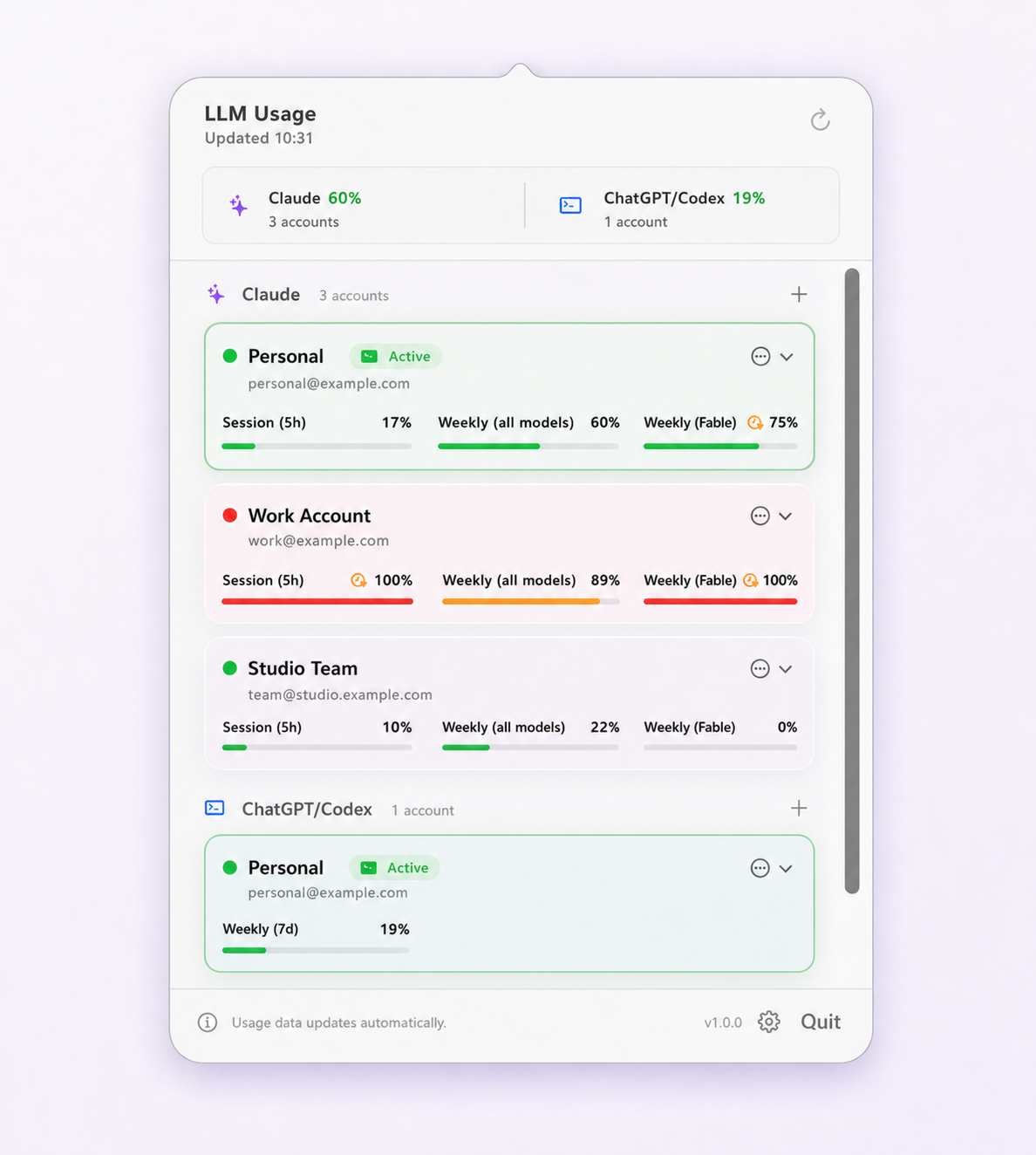
The lineup
These are the dedicated Claude Code account switchers with meaningful adoption, checked against their own repositories on 6 August 2026. This is not a ranking; the order is by current popularity within each form factor.
| Tool | Form | Providers | Licence | macOS signing |
|---|---|---|---|---|
| Limit Lifeboat | macOS menu-bar app | Claude Code and Codex CLI | MIT | Signed and notarized |
| claude-swap | Python CLI with a live dashboard | Claude Code only | MIT | Not applicable (CLI) |
| CCSwitcher | macOS menu-bar app | Claude Code only | No licence file | Sparkle auto-update |
| clauth | Rust CLI, TUI, and MCP plugin | Claude Code only | MIT | Not applicable (CLI) |
| claude-switch | Bash shell function | Claude Code only | MIT | Not applicable (script) |
| Claude/Codex Account Switcher | macOS menu-bar app | Claude Code and Codex CLI | No licence file | Unsigned |
| cc-account-switcher | Shell script | Claude Code only | MIT | Not applicable (script) |
Verified 6 August 2026; star counts, licences and archive status re-checked 30 September 2026. These projects change; check the repository before relying on a row.
- Limit Lifeboat: This site's project, so read the rest with that in mind.
- claude-swap: The largest dedicated switcher, at roughly 2,950 stars, and actively developed.
- CCSwitcher: Roughly 190 stars. Swaps the Keychain item and the oauthAccount block together.
- clauth: The only one here that runs on Linux and Windows as well as macOS.
- claude-switch: Zero dependencies, Keychain-backed, installed as a shell alias such as c work.
- Claude/Codex Account Switcher: Last commit 19 May 2026, so treat it as dormant rather than actively maintained.
- cc-account-switcher: Archived by its author and no longer maintained.
Two notes on the licence column, because it is easy to skim past. A repository with no licence file is not open source in the usual sense — default copyright applies, and you have no granted right to modify or redistribute it, whatever the README implies. And an archived repository will not receive a fix when a provider changes its authentication, which in this category happens regularly.
Which one is "cc-switch"? The name collision, untangled
Before comparing anything, it is worth knowing that at least five projects in this space have near-identical names, and the most popular one does a completely different job. Searching for any of these terms returns a mixture of all of them.
- cc-switch (
farion1231/cc-switch) — a cross-platform desktop app that switches providers: API endpoints and keys for Claude Code, Codex and others. It is not a subscription-account switcher. It is also by an enormous margin the most starred project in this whole area, which is why it dominates every search that touches these names. - cc-account-switcher (
ming86/cc-account-switcher) — a shell script that does switch accounts, but is archived. - CCSwitcher (
XueshiQiao/CCSwitcher) — a macOS menu-bar account switcher, unrelated to either of the above. - claude-switch (
Mamdouh66/claude-switch) and claude-swap (realiti4/claude-swap) — two different projects, one bash and one Python, routinely confused for each other.
The practical test: if the README talks about API endpoints, base URLs or provider keys, it is not solving the multi-subscription problem. Check the repository owner, not just the name, before you install something that writes to your credential store.
What actually matters when comparing switchers
Every tool here can move a credential. Moving a credential is the easy part. The differences that cost you an afternoon are these:
- Write scope. Which files and which keys inside those files does the tool modify? A tool that replaces a whole configuration directory moves your MCP servers, hooks, permissions, and instructions along with the login. If that has already happened to you, recovering a lost MCP configuration covers the way back.
- Verification. After the write, does the tool confirm which account the CLI is actually authenticated as, or does it assume the write succeeded? A credential that moves without the identity moving will happily bill the wrong employer — see checking which account is active.
- Interruption behaviour. If the process is killed halfway, or another process rewrites the credential at the same moment, what state are you left in?
- Concurrency. Do you need one login at a time, or several accounts running side by side in separate terminals?
- Provider coverage. Claude Code only, or Codex CLI as well?
- Maintenance. When was the last commit, and is the repository archived?
Write scope, tool by tool
This is the axis where the projects genuinely differ, and it is worth reading each one's own description rather than trusting a summary.
claude-swap
Saves and restores accounts from Claude Code's own login state and supports parallel sessions alongside a live usage dashboard. It works with the VS Code extension as well as the CLI, which none of the others claim, and it can rotate automatically as an account approaches its limit. Python, MIT, and the most actively developed of the group.
CCSwitcher
Notable because it addresses the failure mode most switchers miss: it keeps a per-account
backup of both the Keychain token and the oauthAccount block in
~/.claude.json, and swaps both on switch. That is the pairing that keeps
the displayed identity honest. Its README is also candid that an in-flight
claude session picks up the new credentials only on its next API call. Claude Code
only, and it ships without a licence file.
clauth
States that a switch “touches only the API keys and the profile's declared env
block in settings.json”. That is a deliberately narrow scope, and it is documented
plainly — but note that it does write inside settings.json, which matters if you
keep that file under version control or share it across machines. It also offers isolated
per-profile config directories through CLAUDE_CONFIG_DIR for running accounts in
parallel, and is the only option here for Linux and Windows.
claude-switch
The minimal end of the spectrum: pure bash, no dependencies, credentials in the macOS Keychain, driven by a short shell alias. If you want something you can read end to end in one sitting before trusting it with a credential, this is the one that makes that practical.
Claude/Codex Account Switcher
Stores credential backups in the macOS Keychain rather than in plaintext config, and keeps Claude and Codex state separate so switching one does not change the other. Its README notes the app is unsigned, so macOS blocks it on first launch until you approve it in System Settings. Its last commit was in May 2026.
Limit Lifeboat
Writes only a fixed list of authentication keys and cannot write outside it:
oauth:tokenCache and oauth:tokenCacheV2 for Claude,
oauthAccount in ~/.claude.json, the value of Claude Code's own
Keychain item, and auth_mode, tokens, OPENAI_API_KEY and
last_refresh in ~/.codex/auth.json. It stages rollback material
first, verifies the resulting identity, and rolls back if verification fails. If another
process rewrites a credential mid-switch, that external change wins and the switch aborts
rather than overwriting it. It does not support parallel sessions.
The honest summary: if you want several accounts live at once, claude-swap or clauth are the right shape and Limit Lifeboat is not. If you want a menu-bar app for Claude Code alone, CCSwitcher is a serious option and handles the identity pairing correctly. If you want one login at a time across both Claude Code and Codex CLI, with the narrowest possible write and an explicit recovery path, that is what Limit Lifeboat is built for.
Usage monitors are a different category
A large group of tools show Claude Code and Codex usage without switching anything. CodexBar is the biggest, with more than 22,000 GitHub stars, and ccusage — which focuses on cost accounting from local session logs — has more than 18,000. Because they only read, they carry none of the credential-writing risk discussed above.
If your problem is purely “how much do I have left”, a monitor is the simpler answer and you should use one. The switchers become relevant only once you have more than one account you are authorized to use and you need to move between them. Some tools, including Limit Lifeboat, CCSwitcher, clauth and claude-swap, do both — and when two of them disagree about your remaining usage, the reasons are knowable.
How to choose
- You only want to see usage. Use a monitor. CodexBar is the obvious starting point, or ccusage if you want cost accounting.
- You want several accounts running at once. claude-swap or clauth.
- You are not on macOS. clauth is the only option here.
- You want a Claude-only menu-bar app. CCSwitcher.
- You want something small enough to audit yourself. claude-switch.
- You use Codex CLI too. Limit Lifeboat.
- You care most about what a switch writes and what happens when it fails. That is the axis Limit Lifeboat is designed around.
Whichever you pick, the policy position is the same for all of them: use only accounts you are authorized to use. None of these tools pools, merges, or extends a quota, and none of them changes how a provider enforces its limits. What the terms actually prohibit covers where the real line sits.
Questions and boundaries
Which Claude Code account switcher has the most users?
claude-swap, among the dedicated switchers. As of 30 September 2026 it has roughly 2,950 GitHub stars, against 451 for the archived cc-account-switcher, 246 for clauth, 186 for CCSwitcher, 65 for Claude/Codex Account Switcher and 31 for claude-switch. Star counts measure attention rather than quality, and the usage monitors are far larger: CodexBar has over 22,000 and ccusage over 18,000.
Is cc-switch the same thing as an account switcher?
No, and this is the most common mix-up in the category. cc-switch is a cross-platform provider switcher that changes API endpoints and keys, not subscription accounts. It is also by far the most starred project of any of them, so it dominates searches for names like cc switch, ccswitch and cc-account-switcher, which are three different projects.
What is the difference between a usage monitor and an account switcher?
A usage monitor reads and displays your remaining limits; it never writes credentials. A switcher changes which account your CLI is authenticated as, which means writing to a credential store. Monitors are the safer category by construction because they only read. Several tools do both.
Is it safe to let a tool write my Claude Code credentials?
It depends entirely on what else that tool writes and whether it can undo a failed write. Ask three questions of any switcher: which exact files and keys does it modify, does it verify the account it landed on afterwards, and what happens if it is interrupted halfway. A tool that swaps whole configuration directories can take your MCP servers and settings with it.
Do any of these tools let me run two Claude Code accounts at the same time?
claude-swap and clauth both support parallel sessions using isolated configuration directories. Limit Lifeboat does not: it switches the single global CLI login one account at a time. If simultaneous accounts are the requirement, the isolated-config approach is the one that fits.
Are these tools affiliated with Anthropic or OpenAI?
No. All of them are independent community projects. None is endorsed by, affiliated with, or supported by Anthropic or OpenAI.