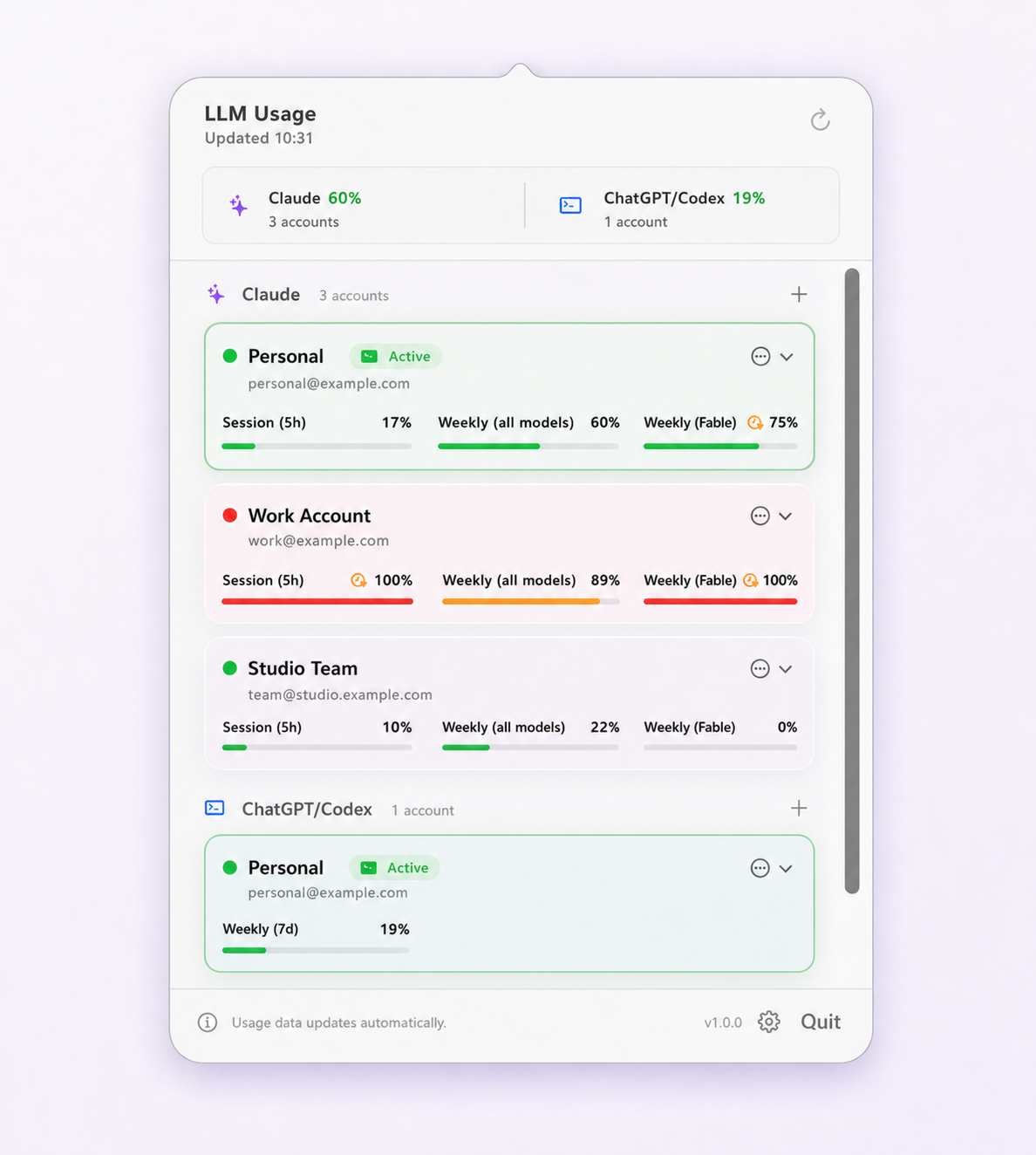
Why there is no clean yes or no
Two different questions get collapsed into one. The first is “may I hold more than one account?” The second is “may I use these accounts the way I am planning to?” The first has a fairly settled answer. The second depends on facts nobody else can see: whose accounts they are, what your employer permits, and what you are doing with the capacity.
Any tool that tells you your setup is definitely fine is selling you something. What an independent project can honestly do is describe the mechanism precisely, so that you can apply your own terms to it. That is what the rest of this page does.
Will you get banned for having a second account?
This question attracts unusually alarming headlines, so it is worth separating what is documented from what is inferred. Nobody outside Anthropic or OpenAI can promise you will not be actioned, and this page does not. What can be said is narrower and more useful: the behaviours associated with enforcement are about how accounts are used, not how many exist.
The distinction that keeps coming up is between multiplying accounts to resell or share inference, and holding separate accounts because separate parties are paying for them. The second is the ordinary consequence of an employer buying you a seat. Both vendors already support that separation elsewhere in their products — OpenAI ships account switching for ChatGPT on the web for exactly this reason.
It is also not a fringe arrangement. The request for built-in multi-account switching in Claude Code has been open since January 2026 and has drawn over seven hundred upvotes, which is a poor fit for the theory that holding two accounts is itself the offence. What has changed is that neither vendor has shipped it for their command-line tools, so people improvise — and the improvisation is where the real risk sits.
The one genuine caution: if several accounts are ever signed in from the same place in ways that look automated or shared, provider systems may flag the activity even when your intent is ordinary. That is an argument for using each account deliberately and one at a time, which is what an account switcher does, rather than for pooling anything.
What providers actually prohibit
Three patterns come up consistently, and they are the ones worth avoiding:
- Account sharing. One subscription used by several people. Subscriptions are priced per person, and giving colleagues access to a single login is the clearest violation in the set.
- Reselling or proxying access. Taking subscription inference and selling it on, or exposing it as a service to others.
- Using subscription credentials in third-party harnesses. Subscription access is sold for use through the provider's own products. Extracting the OAuth token and pointing another agent framework at it is the pattern most associated with account suspensions.
OpenAI's Terms of Use also prohibit circumventing rate limits or restrictions, and Anthropic publishes its own legal and compliance documentation for Claude Code. Read the terms that apply to your accounts rather than a summary of them, including this one.
What gets confused with the prohibited list
Holding a work account and a personal account is not on that list. It is the ordinary consequence of an employer buying a seat: you have a company identity for company work, and your own for everything else. Both vendors support keeping accounts separate elsewhere in their products — OpenAI ships account switching for ChatGPT on the web precisely so that work and personal stay distinct.
What neither vendor has shipped is switching for their command-line tools. The closest
official answer is Anthropic's documented method of giving each Claude Code account its own
CLAUDE_CONFIG_DIR, which keeps logins apart but means maintaining one
configuration directory per account. The gap is why
people write scripts that swap whole configuration directories, and why those scripts quietly
destroy MCP server definitions and settings. The demand is real and mundane; the tooling
around it is where the risk has been.
Why the mechanism matters more than the intent
If you are assessing any tool in this space against your own terms, the question to ask is what it actually does with the credential. Three things separate an account switcher from the patterns above:
- Does the credential leave the machine? If a tool sends credentials to a server, that is a different product with different risks. Limit Lifeboat never transmits them; everything stays in the macOS Keychain and your user Library.
- Does it route model requests? A switcher changes which identity the official CLI uses and then gets out of the way. It never sits in the request path, so it is not a harness.
- Does it give two people one subscription? Switching between accounts you personally hold on your own Mac is the opposite of shared access.
On quotas specifically: switching cannot merge them. Each account's session and weekly windows are tracked and enforced by the provider for that account. Moving the CLI to a second account does not add capacity to the first, and does not change when either resets. If you want the detail on how those windows work, see Claude Code usage limits explained.
Deciding your own case
Four questions settle most situations:
- Is every account one you are authorized to use? Not borrowed, not shared, not someone else's.
- What does your employer permit for the account they gave you? Their policy governs that account, and it may be stricter than the provider's terms.
- Are you using each account through the provider's own tools? If a subscription credential is being pointed at something other than the official CLI, that is the risky pattern regardless of how many accounts are involved.
- Would you describe what you are doing to the provider without hesitating? A useful instinct when the terms are ambiguous.
If you need more capacity on one account rather than more accounts, both vendors document supported routes: Anthropic offers usage credits (formerly called extra usage) and higher plan tiers, and OpenAI sells additional credits. Those are the sanctioned answers to a limit, and they are worth using before reaching for anything else. What to do when Claude Code hits its limit compares the options.
For the practical mechanics of keeping two accounts straight day to day, see keeping work and personal accounts separate.
Questions and boundaries
Will I get banned for having two Claude subscriptions?
Nobody outside Anthropic can promise you will not, and this page does not. What is documented is that enforcement has centred on account sharing, reselling access, and routing subscription credentials through third-party harnesses. Holding a separate employer-provisioned account and a personal account is a common arrangement, but the terms that apply to each account are the ones that govern your situation.
Is using a subscription login outside the official CLI against the terms?
That is the pattern most associated with enforcement. Subscription access is sold for use through the provider's own products. Taking the OAuth token that Claude Code or Codex CLI minted and pointing a different agent harness at it is a materially different thing from switching which account the official CLI is signed in as.
Does switching accounts count as evading a rate limit?
Switching does not change how a limit is enforced. Each account keeps its own provider-enforced quota, and nothing is pooled, merged, or extended. That said, providers prohibit circumventing restrictions, and whether a particular pattern of use crosses that line is a judgment about your use, not about the mechanism.
Can I use my employer's Claude account for personal projects?
That is a question for your employer, not for a provider's terms. A work or enterprise account is typically governed by organization retention, access, and acceptable-use policies that do not apply to a personal account. Ask before assuming.
Is Limit Lifeboat affiliated with Anthropic or OpenAI?
No. It is an independent open-source project, not endorsed by, affiliated with, or supported by Anthropic or OpenAI. It cannot and does not make a blanket claim that every multi-subscription pattern is permitted.